Sunday, 21 March 2021

My life in forests

 Today, the 21st of March, is the day designated by the UN as International Day of Forests. I stumbled upon this piece of information this morning, while researching forest-related issues for a future blog post. A little more investigation of the UN calendar revealed that yesterday was International Day of Happiness, another fact that had hitherto escaped my notice. Now that I know about these important dates, I feel I should mark them – and how better than with a celebration of the happiness that forests have given me?


I am a huge fan of forests. They are, almost without doubt, my favourite place to hang out. Add some mountains (or at least hills), and a lake or river, and I couldn’t be happier. Growing up in Auckland, I was always keen to head west to the Waitakere Ranges for a day’s walking in the bush. Rolling down the car window to get the first smell of it, getting out and heading down the track, surrounded by a gorgeous abundance of trees, ferns, and mosses, a rich mixture of different shades of green, whatever the season. Or better still, leaving the track and heading up one of the many streams that cut their way through the ranges. Wading (or occasionally swimming) through deep pools in dark gorges and scrambling up beside waterfalls, grateful for the knobbly surface of the volcanic rock. Clambering over massive logjams left over from the days when nature was there to be conquered and no one thought twice about cutting down a five-hundred-year-old tree. And always the bush around us – the tall tree ferns, the graceful nikau palms, the straight, solid kauri. Bird song, friendly fantails flitting around our heads, the occasionally whirr of wings when a kereru, a fat wood pigeon, took flight.


At twenty-one I left all this behind me to spend a year in Berlin. Away from home for the first time, I threw myself in the city’s cultural life, going to art galleries, theatres, operas, and concerts. I loved it. And yet the happiest day of that entire year away was one spent at the other end of Germany, in the Black Forest. While visiting a friend in Freiburg I took myself up the hill nearest the town, armed with a sandwich and presumably some water, and then kept on walking. Deciduous forest gave way to dark conifers growing on steep slopes; the sun shone, but among the trees it was cool and quiet. I don’t think I saw another person all day. I didn’t really know where I was – I didn’t have a map, and this was years before smartphones and GPS systems – but it didn’t worry me too much. I ended up in a sparsely populated valley some distance away from Freiburg, found a bus stop, and was back in town by evening. A highly satisfactory adventure.


My positive experience of big city life in Berlin encouraged me to choose London for the next phase of my studies. Here, though, I quickly found myself disenchanted with urban life and craving contact with nature. My first year was spent in Mile End, where the nearest open space was the large and beautifully tended Victoria Park. It was pleasant enough, but it wasn’t wild. You can’t immerse yourself in nature in an urban park. Things improved when we moved east to Leytonstone, and I could begin to explore the southern reaches of Epping Forest – patches of woodland interspersed with meadows, not a pristine wilderness but definitely less civilized than Victoria Park. And then at some point I acquired a map and realized that a short trip by car or by Tube gave me access to the beautiful beech forest further north, and all of a sudden life in London became more tolerable.


Epping Forest was a lifesaver, particularly after the advent of our children. Living in a two-bedroom flat with four small but lively children, we were hugely grateful to be able to bundle them all into the car, drive to Jack’s Hill near Theydon Bois, and head into the woods. We would leave the main paths behind to ramble along narrow side tracks, or leave the paths altogether and just take off cross-country. With small children in tow, we never covered any large distances, but we didn’t have to go far to feel surrounded by nature. Not untouched nature, granted, but nature that had been left for many years to do its own thing. The splendid beech trees, once pollarded, then left to grow uncut – their trunks smooth and grey, their leaves glossy green in summer, brilliantly coloured in autumn, then falling and adding to the thick leaf litter covering the ground, a warm brown brightening the forest in winter. Gnarled roots, cushions of pale green moss. Little streams for the children to play in, fallen trees for them to climb on when they were big enough. The occasional thrill of spotting a deer. But mostly just trees, and space, and the restorative calm of nature.


And now? Living in Chelmsford, I’m still within reach of Epping Forest, but it’s a little far for regular excursions. The woods I have access to near here are not as wild as the Waitakeres, not as vast and lofty as the Black Forest, and not as ancient as Epping Forest, but they have their own appeal. To the east of Chelmsford there are attractive areas of woodland around Danbury and Little Baddow, mostly oak and hornbeam, with lovely displays of wood anemones and bluebells in spring, leafy green shade in summer, vivid colours and fascinating fungi in autumn. On the other side of Chelmsford is Writtle Forest, dominated by sweet chestnut, more oak and hornbeam, and large herds of deer. These are woods rather than forests, and they don’t always offer that truly immersive, uplifting forest experience, but they’re enough to sustain me for the time being.


So let’s raise a glass – or maybe a thermos flask – to forests. Let’s look after them, wherever they are, and make sure they’re there for us humans, and for all the creatures that live in them, for many hundreds of years to come.


Tuesday, 9 March 2021

Queen Charlotte


Artwork by Natalie Eldred

In my previous post on Bridgerton I commented on the anachronistic presence of black characters in British high society in 1813. This strikes me as a pleasing fantasy, slightly marred by the attempt to give it a rational explanation: that the marriage of the English king, George III, to a black woman, Charlotte, has brought about racial equality and harmony. Here I’d like to focus on the precise point in Bridgerton where history intersects with fantasy, the figure of Queen Charlotte.

Played by biracial British actress Golda Rosheuvel, Charlotte is clearly central to the vision of the show’s creators. Showrunner Chris van Dusen has been quoted as saying: “Queen Charlotte opened up an entirely new world for us. What really struck me with the books [the novels by Julia Quinn on which the series is based] from the beginning is that this was an opportunity to marry history and fantasy in a really exciting, interesting way. So in Queen Charlotte, that was the history.” What he doesn’t mention is that while many of the other black characters are reimaginings of white characters from the source novels, Queen Charlotte does not feature in the books at all. So why has she been introduced? Another comment by van Dusen sheds further light on this: “[…] working closely with historians, I learned this really fascinating fact that Queen Charlotte was England’s first queen of mixed race. That’s something that many historians believe there’s evidence for today.” 

Historically, this is highly questionable. The real Charlotte of Mecklenburg-Strelitz was a fair-skinned German princess, born of a long line of German dukes. She was brought to England in 1761 at the age of seventeen, not speaking a word of English, to marry a man she had never met, the young king George III. The wedding contract was signed by her brother; history does not tell us what Charlotte thought about it. Fortunately the couple got on well and evidently led a contented domestic life for over twenty years, until the onset of George’s mental illness. They produced fifteen children, from whom the current royals are descended.


Where did the rumour of Charlotte’s African heritage come from? It was first raised in the 1940s, inspired by this portrait of Charlotte by Allan Ramsay, and a comment by one of Charlotte’s contemporaries that her nostrils and mouth were too wide. In the 1990s, Charlotte was the subject of an article written for American broadcaster PBS, part of a series looking at “blurred racial lines” in the genealogy of various figures in European history.  According to the author, Mario de Valdes y Cocom, his research had revealed that Charlotte was “directly descended from Margarita de Castro y Sousa, a black branch of the Portuguese Royal House”. In a subsequent article Valdes is quoted as mentioning an even earlier possible ancestor, a black Moor called Ouruana (also known as Mandragana or Madragana), mistress of the thirteenth-century Portuguese king Afonso III.

Valdes’s assertions have been convincingly refuted in a number of online articles. See for example history writer Lisa Hilton, anthropologist Jill Sudbury, or this very detailed anonymous essay. The latter text actually examines and publishes some of Valdes’ purported sources. And it includes both formal portraits of Charlotte and contemporary caricatures, none of which give any suggestion of the “conspicuously negroid” features identified by Valdes. Surely such a striking aspect of her appearance would have been picked up and emphasized by the ruthless caricaturists of the time? As well as noting the silence of her contemporaries on this issue, most critiques of Valdes’s theory point out the lack of evidence for the ethnicity of the De Souza family. But ultimately the crucial point is that even if Valdes is right, these ancestors lived hundreds of years before Charlotte. So, to borrow a turn of phrase from Wikipedia, “it’s unlikely that [this] genetic inheritance would have been significant enough to have any noticeable effect on her appearance.”

The surprising thing here is that a sketchy idea put forward by one person in an online article has taken on such a life of its own. If you look up “Queen Charlotte” online, you are more than likely to come away with the impression that she was of African heritage. A Google search produces, as the second hit after Charlotte’s Wikipedia entry, a Guardian article from 2009 entitled “Was this Britain’s first black queen?”. Add “ancestry” as a search term and this moves to the top of the list. Numerous online articles state that “some historians” or even “many historians” believe Charlotte was mixed-race, biracial, or black.

The makers of Bridgerton have picked up this theory and run with it. It’s easy to see why: the notion that Charlotte was England’s “first black queen” or “first mix-raced monarch” fits nicely into their project of celebrating diversity. Is there any harm in this? On a certain level it can be regarded as harmless, perhaps even beneficial. For black viewers who seldom see themselves in Regency dramas, and for black actors who seldom secure leading roles in them, it’s a breakthrough. Golda Rosheuvel, who plays Charlotte, says “I'm biracial. I was brought up in England. My mother was crazy about period dramas, which made me crazy about them. I never thought that I'd be able to be in one. It was something that was far away. I couldn't touch it. Now we can rewrite that story for the little girl who's sitting at home.”

Is it not small-minded and ungenerous for a white viewer who hasn’t had that particular experience of invisibility to begrudge black viewers and actors this sense of euphoria at black visibility? Surely, in the name of diversity, equality, and/or poetic licence, the makers of televised fiction can do whatever they want with history? Caitlin Moran, in her witty review of Bridgerton, lampoons the hypocrisy of anyone complaining about the historical inaccuracy of including black characters in the nineteenth-century British aristocracy. Why, she wonders, does no one ever criticize costume dramas for showing characters with perfect, twenty-first-century teeth?

This seems, on the surface at least, a fair point. It is unreasonable to expect an escapist television show to offer a reliable history lesson. But does this mean that any attempt to criticize fictionalized depictions of history is fundamentally misguided? My feeling is that television has a strong influence on public discourses about all kinds of things, including history, and that this power brings a certain responsibility.

The problem is not so much Bridgerton itself as the way it interacts with the public discourse about Charlotte. Far from admitting that the depiction of the queen is essentially fictional, the show’s makers have perpetuated the idea that it is (probably) a historical truth. As mentioned above, Chris van Dusen has referred to Charlotte’s African ancestry as a “fascinating fact”, and stated that “many historians” believe there is evidence for it.

This is misleading. For most of us non-historians, depictions of historical figures on TV and in film may well be the only insight we have into who they were, what they did, and what they were like. Inevitably, historically inaccurate depictions of such figures leave us with inaccurate perceptions of history. And our perceptions of history – our beliefs about what has happened in the past – have a significant influence on the way we feel and act in the present. All over the world, countless modern-day conflicts are based on resentment about historical injustices.

By feeding into the notion that there really was a mixed-race woman on the British throne in the past, and that this has somehow been hushed up, Bridgerton confirms the idea of a whitewashing of history. I’m not suggesting that the history of black people in Britain and elsewhere hasn’t been suppressed, overlooked, or misrepresented. Undoubtedly it has, along with other aspects of history. But why base the right argument on the wrong evidence? Why not focus on true stories that have been concealed or forgotten? Or create fictional characters whose stories reflect the real historical background?

Frothy and frivolous as Bridgerton is, it raises some interesting questions.


Artwork by Natalie Eldred, https://natalieeldred.uk/


Thursday, 25 February 2021

Fly-tipping

Believe it or not, this isn’t a rubbish dump, it’s a river.


The Wid is an unassuming little river flowing along a shallow Essex valley. It rises in the village of Blackmore, flows south and under the A12, and curves eastward and then northward, not far from the suburbs of Billericay. It passes under the road between Ingatestone and the neighbouring village of Stock, then proceeds in a generally north-eastern direction parallel to the A12 and the railway line connecting London with East Anglia. It doesn’t pass through any large or famous towns, and it disappears from the map after converging with the river Can between Writtle and Chelmsford. Unless you’re a local, you’ve probably never heard of it.

But the Wid has a certain charm. In most seasons it meanders gently through the landscape, flanked by grasses and sedges, stands of willow, and dense thickets of blackthorn. Once or twice a year, maybe more, it changes character when a few days of rain transform it into a fierce, brown torrent. This winter has been particularly wet, and the traces are still apparent: flood-flattened vegetation stained with mud; bare, newly scoured sections of riverbank. For the time being, though, the river is placid again. Soon the blackthorn, now covered in tiny buds, will burst into bloom. Green fields dotted with sheep and cattle, white blossom, birdsong: a walk along the Wid will be an absolute delight.

Except that it won’t, because at some point this winter someone has tipped a lorry-load of rubbish into a ditch by the roadside, near the picturesque bridge linking Stock Lane with Ingatestone Road. That ditch has flooded, and hundreds of black plastic bin liners stuffed with rubbish have been swept into the River Wid. There they’ve been snagged by submerged or overhanging branches, and many have ripped open, spilling all manner of waste into the river. The predominant item seems to be plastic bottles, but there are also tyres, textiles, and other random objects. A spray bottle of blue cleaning agent hangs from a branch. A pink plastic trug with one handle missing sits incongruously on the footpath beside the river. Stray bottles litter the adjoining field, where cows and their calves are grazing. In the river, every twig and stem seems to be festooned with some item of waste. Shreds of black bin liner and other unidentifiable plastics hang from the trees, clusters of bottles and other rubbish have gathered in eddies. It’s an incredibly distressing sight.

I’ve reported this to the Environment Agency and sincerely hope they’ll sort it out. It won’t be easy, though. This isn’t something an enthusiastic band of volunteers could sort out on a Sunday afternoon. The river isn’t navigable with any kind of boat, it may be too deep for wading, its banks are steep and heavily vegetated, and above all, there are tangles of blackthorn and willow in and above the water which make it extremely difficult to move in any direction. There may even be hazardous waste – whoever dumped this rubbish probably wasn’t too concerned about oil or chemicals finding their way into the environment. So the clean-up will require time, agility, and the right equipment. And even if the worst section is cleaned up, some of the waste is bound to have escaped: some of those bottles will have bobbed down the Wid into the Can, then down the Can into the Chelmer, and from there into the Blackwater Estuary and eventually the North Sea.

Presumably whoever dumped this waste didn’t intend to have it spread down a quarter of a mile of river and riverbank. But what did they intend? Did they think a concerned member of the public would see the rubbish near the roadside and report it to the council, and that the council would clean it up? Or, given that it was most likely on private land, did they think the landowner would deal with it? Perhaps this would have happened if nature hadn’t intervened with a catastrophic flood. On the whole, though, we have to assume that people who illegally dump waste by the roadside don’t really care what happens to it, because even if the public is quick to report things and councils and landowners are quick to act, there’s always a chance that the waste will be dispersed by wind, traffic, or animals, and that some of it will remain in the environment.

Can anything be done to prevent this kind of thing happening? As individuals, all we can do (apart from reporting fly-tipping if we see it) is dispose of our own waste responsibly. In the UK (or in Chelmsford at least) we’re lucky to have effective kerbside rubbish collection and recycling services and free municipal recycling centres where there’s an appropriate place for everything. If we can’t take our rubbish to the tip ourselves, then we need to double-check the credentials of anyone removing it for us. If we’ve accumulated a front yard full of waste from a building project or a house clear-out, and a friendly passer-by offers to dispose of it for fifty quid, we should almost certainly say no.

Sadly, however, there will always be people who don’t care where their waste goes, as long as it doesn’t cost too much. In those cases we probably have to rely on councils and landowners to put up cameras in popular fly-tipping spots so the culprits can be caught and prosecuted. You never know, it might deter others.

One thing that might have helped in this particular case would have been the existence of a deposit scheme for plastic bottles. My theory is that the rubbish currently clogging the Wid was dumped by (or on behalf of) a dodgy landlord, clearing up after an untidy tenant. The tenant had a fondness for fizzy drinks, and left hundreds of plastic bottles in the house. Now if each of those bottles were worth twenty pence or more, what are the chances that they would have been allowed to accumulate for so long? Isn’t there someone in every family who needs a bit of extra cash for chocolate or cigarettes or hair dye or fake eyelashes? I’m thinking children and teenagers whose pocket money doesn’t quite go far enough – wouldn’t they be willing to scramble around gathering up bottles, and take them to the local shop to collect the deposit? If empty coke bottles were worth something, I’m certain that fewer would end up on roadsides and in rivers.

As for the Wid, I’ll be going back there over the next few weeks to check whether the Environmental Agency or the local council has leapt into action – and to see if the blackthorn is in bloom.


22 March 2021: UPDATE: New rubbish has been dumped in the ditch next to the road. Not a large quantity, perhaps a van-load rather than a lorry-load; black bin bags full of domestic waste: pet food tins, plastic and cardboard food packaging.

I'm slightly less sure of my theory about where the original waste was dumped, because there's a lot of vegetation between this dumping spot and the river, and I'm not sure all those bags could have got through it. There's a much clearer ditch on the opposite side of the river, with less parking space but just enough room to stop, so that's also a possibility. I'm also less sure about my house-clearance theory - the new rubbish is just everyday household waste. Is it being dumped because whoever produced it couldn't be bothered sorting it, and couldn't fit it into their grey 'non-recyclables' bin? It's puzzling.


As for the rubbish in the river, it's still there. The pink trug has been moved to the side of the path, but apart from that, not much has changed. The blackthorn isn't out yet, but there are patches of lesser celandine creating cheerful splashes of yellow among the rubbish on the riverbanks. If anyone is going to attempt a riverbank clean-up, this would be the time, before the nettles and brambles grow up and make it impossible to see and/or reach.

I've reported the new fly tipping to Brentwood Council, and I've spoken to the Environment Agency again. They've just got back to me to say that the matter has been handed over to the local councils. To make matters more complicated, it seems Chelmsford Council is responsible for one side of the river, and Brentwood for the other. Sounds like a recipe for inaction, especially as the worst of the rubbish is in the middle of the river. But let's hope I'm wrong!


Tuesday, 9 February 2021

Bridgerton


Within a month of its release on Christmas Day 2020, Bridgerton had been streamed by 82 million households worldwide, making it Netflix’s most-watched series ever. How are we to explain this extraordinary success? I have investigated.

Bridgerton offers much to please the eyes and the heart. The hero, Simon Basset, Duke of Hastings, is undeniably handsome. The heroine, Daphne Bridgerton, starts off as an innocuously pretty ingénue and graduates to a luminously beautiful bride as the series progresses. The build-up of lust and longing between them is a pleasure to watch. The colours are bold, the costumes gorgeous, the decors sumptuous. There’s sexual tension. There’s sex. In short, there’s plenty to enjoy.

There’s also plenty to quibble at. Bridgerton is not subtle, for a start. Many of its characters are overdrawn to the point of caricature, and the dialogue is often clunky and clichéd. It signals its messages very obviously. Women are oppressed, prevented from making their own choices in life. Society upholds a sexual double standard, allowing gentlemen to sow their wild oats while their sisters must remain chaste. A lady’s fragile reputation is ruined if she is so much as seen unchaperoned in the company of a man.

The clearest illustration of this patriarchal double standard is the heroine’s brother, Anthony Bridgerton. Left as head of the family after his father’s death, he struggles to impose his authority on his mother and siblings. When we first glimpse him he is engaged in upright outdoor sex with a lusty brunette – his opera-singer mistress – when he should be attending to family duties. Later, he speaks of his obligation to find a suitable match for his sister Daphne and protect her virtue. His lover notes with envy that not every woman is afforded such gallant protection, to which he replies:  “Every woman is not a lady”.

Back home, Anthony’s efforts to do his duty also cause much distress: he finds fault with almost all Daphne’s suitors, but inexplicably accepts an offer from the deeply unattractive Nigel Berbrooke. Daphne’s reluctance is irrelevant. It is only after learning that Berbrooke has made an attempt on his sister’s honour that Anthony loses enthusiasm for the match. Despite his smouldering good looks, slightly reminiscent of Colin Firth as Mr Darcy (or is it just the hair?), Anthony’s pompous, misguided attempts at playing paterfamilias turn him into something of a villain.

At times, the plight of oppressed women is overshadowed by another message, less explicitly stated but no less obvious: that good taste goes hand in hand with virtue, and that bad taste is almost as contemptible as immorality. This is exemplified by the contrast between the Bridgerton family and their neighbours, the Featheringtons.

The series begins as the season’s debutantes prepare for their presentation to the queen. In the Featherington household, older sister Prudence is being laced into her stays, ever tighter, while the voiceover (soon revealed to be the commentary of the mysterious, pseudonymous gossip columnist, Lady Whistledown) introduces the Featherington daughters as “Three misses, foisted upon the marriage market like sorrowful sows by their tasteless, tactless mama”.

Cut to the elegant, wisteria-clad house across the square, home of the Bridgertons, where all is good taste and clean family fun. A clutch of perfectly handsome sons and perfectly beautiful daughters (as noted by Lady Whistledown), only one of whom is to be thrown upon the marriage market this season. As the three Featherington girls are squashed onto the seat of a slightly too-small carriage, opposite cross mama and indifferent papa, the Bridgerton carriage – despite the presence of mother and three younger sisters – gives debutante Daphne ample space for her tasteful gown and perfectly balanced tiara, and no family squabbles distract her from gazing in wide-eyed wonder at the view.

At the palace, the three Featherington misses make an undignified attempt to squeeze simultaneously through the door of the queen’s audience room. Even the official announcing their names seems to feel their number is excessive. Herded forward by mama, they curtsy inelegantly to the bored monarch, and one – perhaps the too-tightly-laced Prudence – faints dead away, eliciting a faint expression of disgust from queen and courtiers.

No such jostling for Daphne: her entrance is graceful, her curtsy elegant; she radiates purity and loveliness. The jaded queen stands and walks toward her, raises her demurely dropped chin, places a kiss upon her forehead, and declares her flawless.

Artwork by Natalie Eldred

In short, Daphne is an object of admiration, envy, and desire, while the Featherington girls inspire at best pity, at worst sniggers of scorn. They are essentially a foil for her beauty, a bit of comic relief. One of my most enduring images of Bridgerton is that of the chubby and querulous red-headed Penelope Featherington, squeezed into a series of unbecoming pink and yellow dresses by her tasteless mama, and trying desperately to rescue the object of her affections from the schemes of a prettier rival. The cards are stacked against Penelope from the start. She does eventually extricate her beloved – the bland and oblivious Colin Bridgerton – from romantic peril, but has no chance of winning him any time soon. Poor Penelope.

Besides its simplistic messages and its casual cruelty towards redheads, there is something a little disconcerting about Bridgerton’s treatment of race. The novels on which it is based, by American writer Julia Quinn, depict the lives of the white upper classes in Regency London; the hero’s icy blue eyes are a key feature. The TV series casts some of the key characters as Black, most notably the leading man Simon, his mentor Lady Danbury, and Queen Charlotte (who does not feature in the novels). People of other ethnicities also appear occasionally at the margins of the action. Initially this appears to be a case of non-traditional or colour-blind casting – race is simply not mentioned. But then, twenty minutes into episode four, when Simon has ended his friendship with Daphne and is on the point of leaving England, Lady Danbury reminds him that it is love that has “allowed a new day to begin to dawn” in British society. “Look at our queen. Look at our king. Look at their marriage. Look at everything it is doing for us, allowing us to become. We were two separate societies, divided by colour, until a king fell in love with one of us.”

The action moves on, and there is no further discussion of the matter in this or subsequent episodes. Yet the presence of this isolated explanation, this shift from colour-blind fantasy to revised history, draws attention to its own plausibility, its internal coherence. Could such a transformation have been achieved within the reign of a single monarch? Does the extraordinary wealth of Simon’s family, the grand house in London, the even more spectacular country mansion, match this narrative of newly acquired privilege? Were it not for Lady Danbury’s speech, we could simply enjoy seeing ethnically diverse actors on screen in a lavish Regency romance, without worrying about the whys and wherefores. Might it not have been better to leave this altogether undiscussed rather than to raise it so fleetingly?

Such quibbles aside, there is no doubting the hero’s appeal. Simon has overcome a lonely and difficult childhood (we are left in no doubt as to just how lonely and how difficult it was) to become an astonishingly well-adjusted adult. Tall, strong, handsome, and fabulously wealthy, he is the prize every match-making mama dreams of. But there’s a catch: he has sworn, at the deathbed of his despised father, never to marry or to sire an heir. Will Daphne be the one to overcome his resolution?

Various classic scenes show the growing attraction between them. Dancing at a society ball, the two gradually move closer, and Simon’s hand (bruised from punching the persistent and ungentlemanly suitor Berbrooke) moves up from the back of Daphne’s dress to rest, momentarily, on her bare skin. There is a moment of great sweetness where the two stand side-by-side to discuss a painting, and their hands move almost involuntarily into a quick clasp that leaves them both breathless. And then there is the occasional departure from the traditional script. Desperate for a little information, Daphne asks Simon what goes on in a marriage. Rather unexpectedly, he suggests it is a natural extension of what happens at night, “When you touch yourself. You do… touch yourself?” Faced by her obvious bewilderment, he gives a quick set of instructions. She follows these at the next opportunity, to very satisfactory results. The subject matter of this conversation seems highly unlikely – would a nineteenth-century gentleman, even one with the reputation of a rake, see marital sex as a continuation of masturbation? And would anyone assume a well-bred young lady was enjoying herself alone in bed? But the dialogue is delightfully sexy: promenading in a public park, the two are just out of earshot of their chaperones, and have to stand mere inches apart to hear each other – cue close-ups of hungry eyes and trembling lips.

There is much to unpick and discuss about Bridgerton’s sexual politics and its treatment of history – and I may return to this – but in the end the question of its appeal is not difficult to answer. The romance between Simon and Daphne, moving not altogether unpredictably from sham flirtation to genuine affection and attraction, is the beating heart of the series and the main reason to overlook its many absurdities and keep watching. It will be interesting to see whether the second season will find an equally compelling central thread, and satisfy the viewers pulled in by season one.


Artwork by Natalie Eldred, https://natalieeldred.uk/


Bridgerton 2

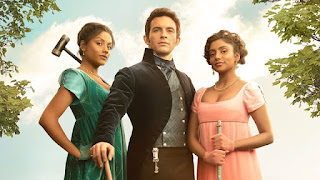
I launched this blog early last year with a post exploring the appeal of the Netflix series Bridgerton (if the details are a little hazy you...